
The Art of Energy
Death Tarot Meaning: Transformation, Endings & Rebirth
Discover the complete Death tarot meaning for love, career, and personal transformation. Explore upright and reversed interpretations, release guidance, and the rebirth behind this Major Arcana card.

Few tarot cards make people tense up as quickly as Death. The name alone can trigger fear, superstition, or the assumption that something terrible is about to happen. But in tarot, Death almost never means literal death. Its deeper message is more honest, more demanding, and in many ways more useful: something has reached its end, and your life is asking you to stop pretending otherwise.
Death is the card of transformation that cannot happen without release. It appears when a chapter has completed itself, when an old identity no longer fits, or when a situation must change so that something more truthful can begin. That is why this card often feels intense. It is not gentle about stagnation. It shows where life has already moved on, even if part of you is still gripping what used to be.
This guide covers the full Death tarot meaning, including upright and reversed interpretations for love, feelings, career, and personal growth.
Quick Answer: What Does Death Mean in Tarot?
Death usually means a necessary ending, release, and transformation. It does not predict literal death. It appears when a relationship, role, habit, or version of yourself can no longer continue in the same form.
- Upright: an ending makes space for renewal.
- In love: a relationship or old pattern must change honestly.
- In feelings: emotions are shifting, grieving, or letting go.
- Reversed: change is real, but resistance is delaying it.
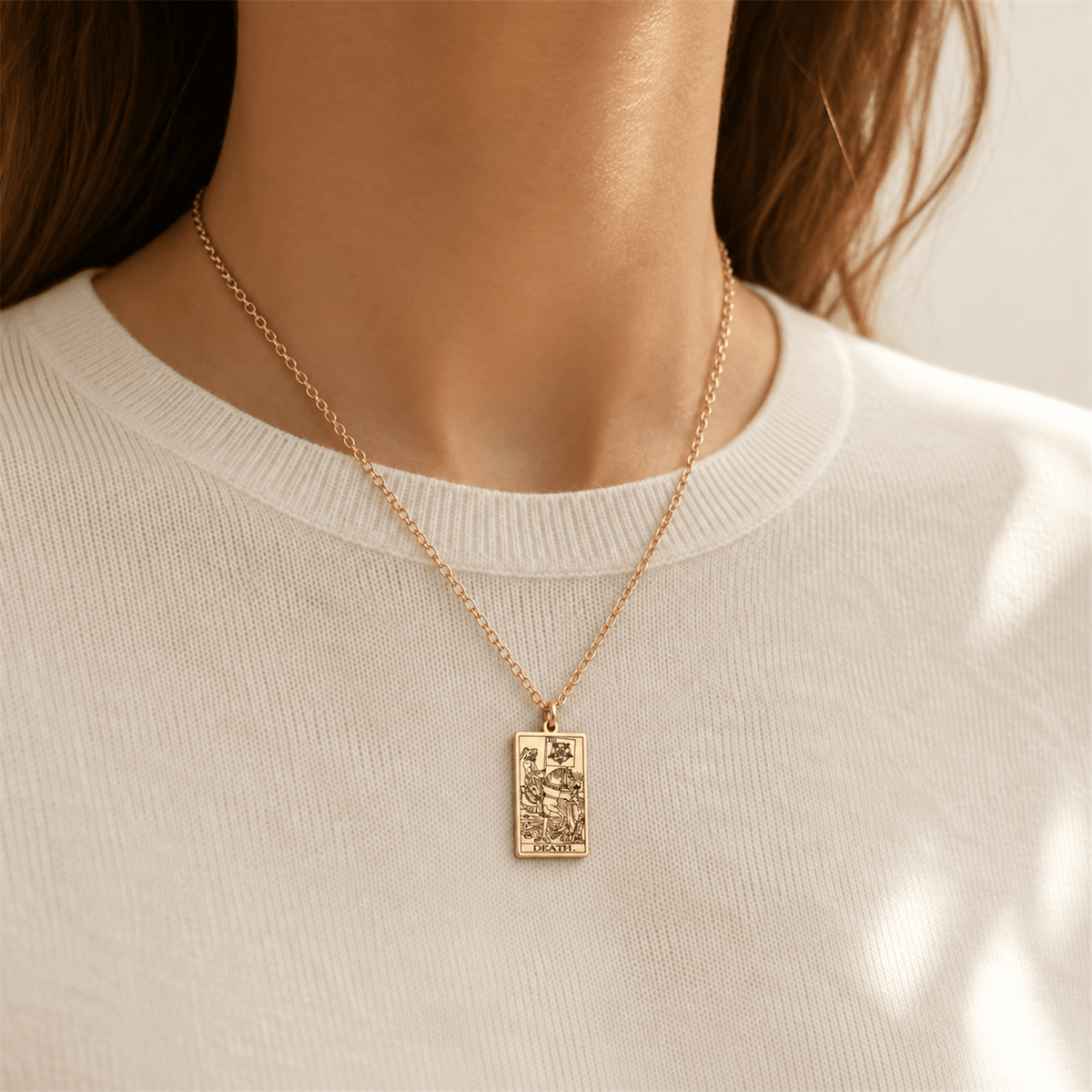
If Death was your card today, you can also explore the Death jewelry collection for pieces associated with this card.

Symbolism and Essence
Death is not about punishment. It is about the law of endings. Everything in life moves in cycles: growth, fullness, decline, release, renewal. Death belongs to the part of the cycle most people resist, because it asks you to let go before you can see what comes next.
That is why this card can feel both severe and liberating. It names what is over. It strips illusion from what can no longer continue in the same form. But it also clears space. The emptiness that follows an ending can feel frightening at first, yet it is often the exact space new life needs.
Traditional imagery explains this tension well. Death rides forward with quiet certainty. Around it, titles, defenses, and social roles lose their power. Nothing argues successfully with the truth of change for long. The image can look dark, but it is also strangely clean. Death does not arrive to humiliate you. It arrives to remove what has already completed its role.
This is why the card belongs to transformation rather than disaster. It is the point where denial becomes heavier than honesty, and release becomes the only path back into flow.
Death Upright Meaning
Upright, Death points to endings, transitions, release, and irreversible change:
- A chapter closing, whether or not you feel ready
- Outgrowing a relationship, role, habit, or identity
- Shedding what has become stagnant or life-draining
- A period of grief that clears the way for renewal
- Major personal transformation
- The truth that change is no longer optional
Death is rarely comfortable, but it is often clarifying. When this card appears, the deeper question is not "How do I keep this exactly as it is?" but "What am I being asked to release so that life can move again?"
Death in Love
In love readings, Death often signals that a relationship dynamic is changing in a meaningful way. Sometimes that means a bond is ending. Sometimes it means an old way of relating can no longer survive. Either way, the card asks for honesty.
If you are single, Death can show that your love life is changing because you are changing. You may be leaving behind old patterns, old attachment styles, or an outdated idea of what love is supposed to look like. That process can feel lonely in the middle of it, but it often prepares the ground for a healthier kind of connection.
If you are in a relationship, this card may point to a major transition: a breakup, a turning point, or the end of a pattern that has kept the relationship stuck. In some cases, a partnership survives Death energy, but only because something false within it has to die first. Pretending nothing needs to change will not work here.
What matters most is that Death does not support half-hearted transformation. If love is going to continue, it must do so in a more truthful form.
If Death speaks to your current season, it may help to stay with this card beyond the reading itself. In the Death jewelry collection, you can explore pieces connected to this card's energy of release, renewal, and becoming.
Death in Feelings
In a feelings position, Death often shows emotions that are changing profoundly. Someone may be moving through grief, detachment, or an inner ending they have not fully expressed yet. This does not always mean they feel nothing. In fact, it can mean they feel the situation so intensely that they know it cannot continue in the same way.
Sometimes Death in feelings suggests that someone is trying to let go. Sometimes it suggests that they are being transformed by what they feel, even if they do not yet know how to respond. The emotional tone here is serious. Something is shedding. Something is closing. Something deeper may eventually grow from it, but not before a real ending is acknowledged.
That is why Death in feelings is not a "quick answer" card. It describes emotional transition, not emotional convenience.
Death in Career and Life Path
Outside romance, Death often appears when work, direction, or self-concept is undergoing a major shift. A role may be ending. A goal may no longer fit. A version of success you once chased may suddenly feel empty.
In career readings, this can signal:
- Leaving a job, team, or industry
- A necessary restructuring
- The end of a project or phase
- Burnout that forces re-evaluation
- A stronger calling emerging after something old falls away
The card asks you to notice where you are trying to preserve what has already expired. Sometimes the career path itself is not wrong, but the way you have been inhabiting it has become too narrow. Other times, the ending is more direct: something really is over, and the healthiest move is to stop negotiating with that fact.
In a broader life reading, Death points to identity-level change. The old story is breaking apart. You are not who you were, and life is not asking you to go back.
Death Reversed
Reversed, Death often points to resistance to change. The ending may already be happening, but part of you is holding on anyway. That resistance can show up as delay, denial, emotional paralysis, or the exhausting effort of keeping something alive past its natural ending.
In love, reversed Death may suggest clinging to a relationship dynamic that has already run its course, or trying to preserve connection without allowing the transformation it requires. In personal growth, it may show fear of stepping into the unknown, even when the known has become deeply limiting.
At times, reversed Death can also point to a transition that is happening slowly rather than all at once. The release is real, but it is unfolding in stages. Even then, the core message remains the same: life is moving, and your task is to move with it.
This is why reversed Death should not be read as "nothing is changing." Usually, it means change is being delayed by attachment.
Advice from Death
Death does not ask you to become dramatic. It asks you to become honest. If something has ended, name it. If something is leaving your life, stop spending all your energy trying to drag it back into place. If part of your identity has expired, let it go with dignity instead of forcing it to stay.
This card is often advice to release:
- old stories
- old resentment
- old expectations
- old roles
- old versions of yourself that cannot carry you forward
Death reminds you that grief and renewal are not opposites. They often arrive together. The release hurts because it mattered. But the hurt is not proof that you should refuse the transformation. Sometimes it is proof that the transformation is real.
If you are asking for guidance, Death points toward the path of surrendering what is over so you can make room for what is next.
Death and Rebirth
The most important thing to understand about Death is that it is not really an ending-only card. It is an ending-for-the-sake-of-rebirth card. Tarot gives this truth in a stark form because many of us would never choose change if comfort were still available.
After Death, life does not disappear. It reorganizes. New values become visible. New energy returns. New identity emerges. But rebirth only has integrity when it comes after genuine release. Otherwise it is just rebranding old stagnation.
That is why Death can become one of the most empowering cards in the deck. It teaches that you do not have to remain loyal to what is already complete.
Frequently Asked Questions About Death
Q: Does the Death card mean literal death?
A: Usually no. In tarot, Death almost always means ending, transition, transformation, and release, not physical death. It points to change that is significant enough to close one chapter and open another.
Q: Is Death a bad tarot card?
A: Death can feel intense, but it is not inherently bad. It is a truthful card. It appears when something is over, stagnant, or ready to transform. That can be painful, but it often leads to a healthier future than continued denial.
Q: What does Death mean in love?
A: In love, Death often points to a major transition: the end of a relationship, the end of an unhealthy pattern, or the transformation of a bond into a more honest form. It asks whether the relationship can survive change, not whether it can stay untouched.
Q: What does Death mean reversed?
A: Reversed Death often means resistance to change, difficulty letting go, or delaying an ending that has already begun. The transformation is still there, but attachment is slowing it down.
Q: What does Death mean for feelings?
A: In feelings, Death suggests emotions that are changing profoundly. Someone may be letting go, grieving, or moving through an inner ending. It is a serious and transitional emotional card rather than a light or casual one.
Q: What is the spiritual lesson of Death?
A: Spiritually, Death teaches surrender. It asks you to trust that release is part of the cycle of becoming. Something must end so that something truer can begin.
Continue with This Card
If Death is speaking to your current season, take the next step that matches what you need now:
- Draw your card — For a new reading when you are not looking for Death specifically
- Explore the Death collection — A quieter route into jewelry after you have understood the card
You can also explore nearby cards in the same shadow-work and transformation path:
- The Devil card page — Attachment, desire, shadow, and self-honesty
- The Tower card page — Collapse, breakthrough, and revelation
- Judgement card page — Awakening, rebirth, and answering a higher call
- View All 22 Major Arcana Cards
Related articles:
- How to Read Tarot for Beginners — Build a stronger foundation for reading difficult cards
- The Moon Tarot Meaning — Keep reading through uncertainty, intuition, and emotional change
- Tarot & Crystals: How to Amplify Your Energy Resonance — Support transformation work with symbolic ritual
This complete guide covers Death tarot meaning including upright and reversed interpretations for love, career, feelings, and spiritual transformation. Bookmark this page as your reference for endings that lead to truth, release, and renewal.

Explore the Death Card
Explore Death JewelryThe Death Collection




Begin Your Reading
Pull a daily card, or wear the arcana you are working with.


