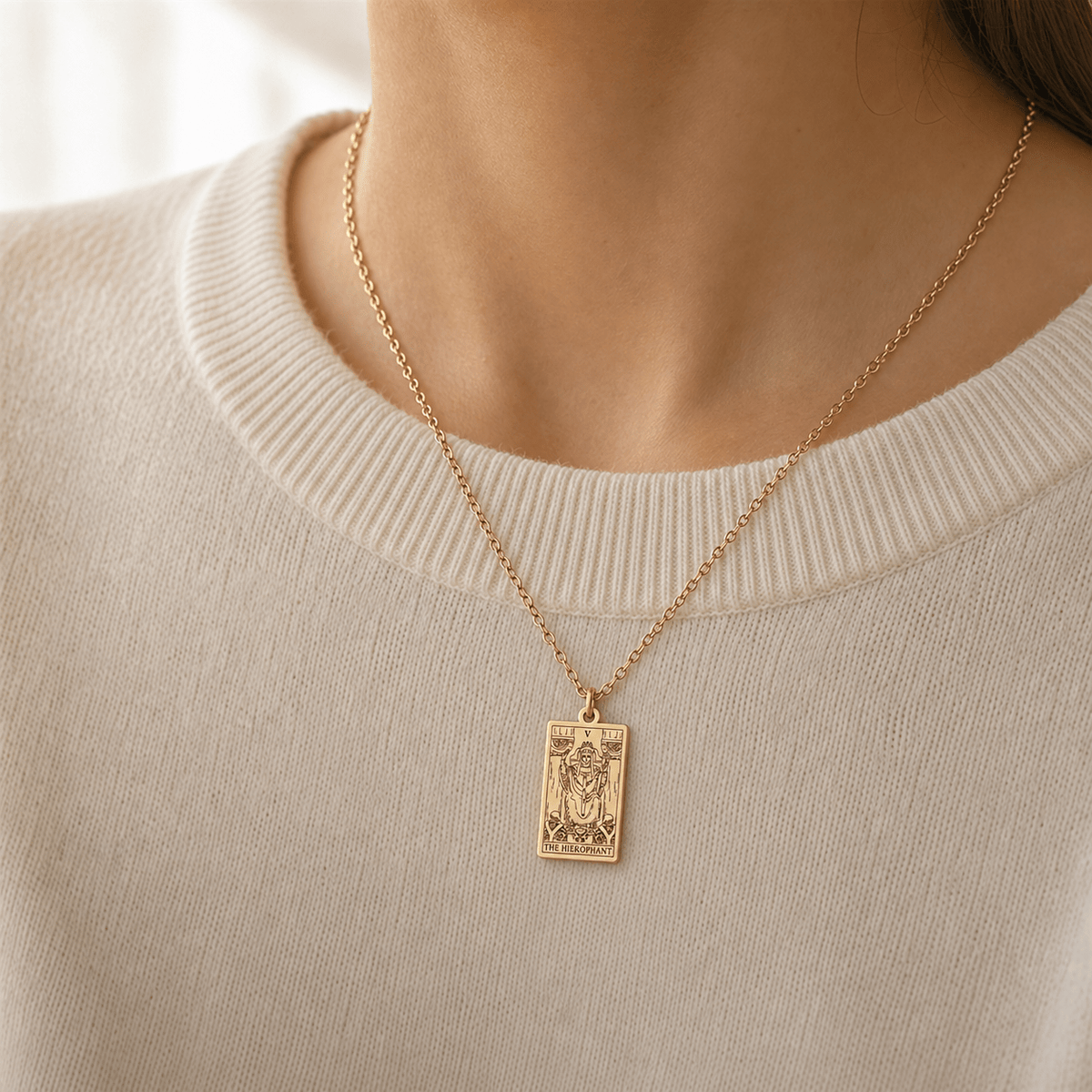

Most readers glide past The Hierophant on the way to The Lovers, his flashier neighbor. That is a little unfair. Nearly every meaningful question in a reading — commitment, career, faith, family — eventually runs into the territory this card governs: the rules we inherited, the teachers we trust, and the difference between belonging somewhere and just agreeing with it.
The Hierophant is tarot's card of tradition. Depending on your life, that word will feel like either a shelter or a cage. The card works precisely because it can be both, and it asks you to notice which one it is being for you right now.
This guide covers The Hierophant upright and reversed, with interpretations for love, feelings, career, and questions of belief.
Illustration: Tarotara artwork for The Hierophant. The symbolism discussed below follows the Rider–Waite–Smith tradition; details vary between decks.
Quick Answer: What Does The Hierophant Mean in Tarot?
The Hierophant usually means tradition, teaching, institutions, and wisdom tested by time.
- Upright: learn the rules before you break them; use the structure that already works.
- In love: commitment in a recognized form — marriage, family, shared tradition.
- In feelings: serious, conventional, oriented toward something defined.
- In career: credentials, mentorship, established institutions, playing by the book.
- Reversed: questioning dogma, leaving the beaten path, or rules that have outlived their purpose.
For pieces connected to this card, explore the Hierophant jewelry collection.
The Imagery: A Teacher With an Audience
The Hierophant sits between two pillars like a temple door. One hand holds a staff of authority; the other is raised in blessing. Two figures kneel before him — students, clergy, followers — and at his feet lie two crossed keys.
The crossed keys invite a reading of tradition as access to knowledge gained by others. The kneeling figures bring teaching and learning into the scene: a practice received from someone, then examined in your own life.
Compare him with The High Priestess, who sits between pillars of her own earlier in the deck. She keeps knowledge hidden and personal; he hands it out, codified, in a form a community can share. Read side by side, they frame one question from opposite ends: every inner knowing eventually faces the question of whether it can be lived with others.
The Hierophant Upright Meaning
Upright, The Hierophant points to structure you did not invent but can still use:
- education, training, certification — learning from people who went first
- mentors worth seeking and elders worth consulting
- ceremonies and rites of passage that hold meaning because they are shared
- communities, teams, and traditions that provide belonging
- the accumulated wisdom of "how this is normally done"
The card is not automatically conservative in spirit. Its deeper test is whether the tradition you are standing in still transmits something true. A practice kept because it works is very different from a practice kept because questioning it was never allowed. The Hierophant upright invites the first and merely tolerates the second.
The Hierophant Tarot Meaning in Love
In love readings, The Hierophant speaks the language of commitment in a recognized form. Marriage. Meeting the families. Religious or cultural ceremony. Building a relationship inside a framework your communities can see and bless.
If you are in a relationship, the card often appears when the question is no longer do we love each other but what form will this take — and it leans toward the established path, especially when both people genuinely want it rather than performing it for an audience.
If you are single, The Hierophant can describe the kind of partner you are hoping to find: someone serious about shared values, family, and a defined future. It can also pose a fair challenge — how much of what you want in a partner is your own desire, and how much is a script you absorbed without choosing it? Our guide to The Lovers tarot meaning is a useful companion here, since The Lovers asks the same question from the opposite direction: individual choice first, then tradition. Read the full Lovers card page and the two cards together form a complete conversation about commitment.
The Hierophant Tarot Meaning for Feelings
In a feelings position, The Hierophant can suggest a wish for commitment, shared values, or a relationship with a clear place in everyday life. Family and tradition may matter.
Ask what commitment means to each of you. It is also worth examining whether the form you want suits your own needs or mainly satisfies an expectation you inherited.
The Hierophant in Career and Belief
Career readings under The Hierophant favor institutions and transmission: universities, corporations, licensure, unions, family businesses, the professions. Upright, it supports getting credentialed, apprenticing to a master, respecting the culture of an organization you have joined, or becoming the person who trains others.
The card also governs belief more broadly — the systems, from religion to professional codes, that tell people how to live well. When it appears, a useful question is whether your current framework is feeding you or merely occupying you.
A note on tone: The Hierophant is not "the boring card." Communities, rituals, and elders answer a real human need that lone-wolf cards cannot. Many readings that feel stuck are stuck for lack of exactly what this card offers — a framework bigger than one person's mood.
The Hierophant Reversed Meaning
Reversed, The Hierophant marks friction with the tradition itself. The usual readings:
- Questioning the dogma. You have outgrown a framework — a church, a company line, a family script, a school of thought. The card reversed often appears right before someone stops outsourcing their authority.
- Reforming from inside. Not every departure is an exit. Sometimes the card reversed describes the person who loves their tradition enough to challenge how it is currently practiced.
- False teachers. Institutions that have drifted from their stated values, or authority figures who demand conformity while exempting themselves. If the surrounding cards are uncomfortable, weigh this reading seriously.
- Unquestioned rule-following. The flip side of rebellion: following the script so automatically that you have stopped noticing whether it leads anywhere you want to go.
The reversal is not an argument for lifelong contrarianism — that is just dogma with a minority accent. Its real work is making tradition a choice: keep what you have examined, release what you have only inherited.
The Hierophant Yes or No Meaning
The Hierophant leans yes for questions about formalizing, joining, studying, marrying within a shared tradition, or seeking expert help. It is a soft no or not this way when the question involves shortcuts, unorthodox experiments, or going against an institution that holds real power over the outcome. Reversed, the answer often means the conventional path is available but no longer honest for you.
The Hierophant and His Neighbors
Authority has several models in this deck. The Emperor holds personal and state power; The Hierophant holds shared belief and meaning. The Hermit later walks alone to verify truth firsthand — the journey many people make after a Hierophant reversal. And The Lovers, as noted above, tests tradition against individual choice.
For a map of all twenty-two cards and how they sequence, the Major Arcana complete guide places The Hierophant in the longer story of the Major Arcana.
Frequently Asked Questions About The Hierophant
Is The Hierophant a bad card?
Not at all. "Boring" is the reputation; the reality is stability, learning, mentorship, and belonging — foundations most readings need. Its warnings concern conformity without thought, not tradition itself.
What does The Hierophant mean in love?
Commitment in a recognized, often traditional form: marriage, family, shared religion or culture. It can also prompt the question of whether the traditional path is actually yours or merely expected.
What does The Hierophant reversed mean?
Friction with tradition: questioning dogma, leaving an institution, encountering a false teacher, or following rules too automatically. It favors examined belief over inherited belief.
What is the difference between The Hierophant and The Emperor?
The Emperor rules through structure and personal authority; The Hierophant rules through shared belief, teaching, and institutions. In practical readings: The Emperor is the boss, The Hierophant is the school, church, or company culture.
Continue with The Hierophant
- Draw your daily tarot card — one card, one question, today.
- Explore The Hierophant collection — jewelry for teachers, seekers, and keepers of tradition.